A few Latin words have survived into modern leadership vocabulary almost unchanged. "Gravitas" is one of them — it has lost none of its prestige, and still carries the same quiet authority it held in Ancient Rome. As we study leadership under extreme conditions in cockpits, on the ISS, beneath the ocean — it seems the Romans were asking a version of the same question two thousand years before us: what does it take to hold a person, or a team, together when the stakes are highest?
The Romans, of course, had no management manuals or corporate training courses. What they had was the so-called mos maiorum, the "custom of the ancestors" — an unwritten code that shaped the behavior of every citizen, and held military commanders and emperors to a demanding standard [1][2].
Mos maiorum wasn't a list of rules handed down from above, rather, a living set of examples: the exempla of the ancestors, their deeds and words, invoked to justify — or criticize — their present conduct [3]. Notably, Cicero and Sallust built entire speeches on this mechanism. It actually worked because it was shared: a general who broke the fides he owed his allies didn't just lose face, he lost dignitas — a public reputation more valuable, in Rome, than money or any other material possession or wealth [1][6].
The pillars of Roman military leadership
Among the values of the mos maiorum, several were considered indispensable for anyone in high leadership positions like commanding armies or governing the state:
Virtus, for example, was not simple physical courage, but a combination of moral strength, excellence, and a sense of what was right. Originally, the word denoted something more specific and more martial: battlefield dominance and "manly" potency, derived directly from vir, "man" [11][12].
A study published in Personality and Individual Differences identifies Gravitas as the single most significant personality trait of Roman leadership: dignity, self-control, and the capacity to remain "steady" even in the gravest situations [4]. The same study notes that Cicero famously attacked Verres precisely by accusing him of lacking gravitas — a rhetorical weapon as much as a moral one [4].
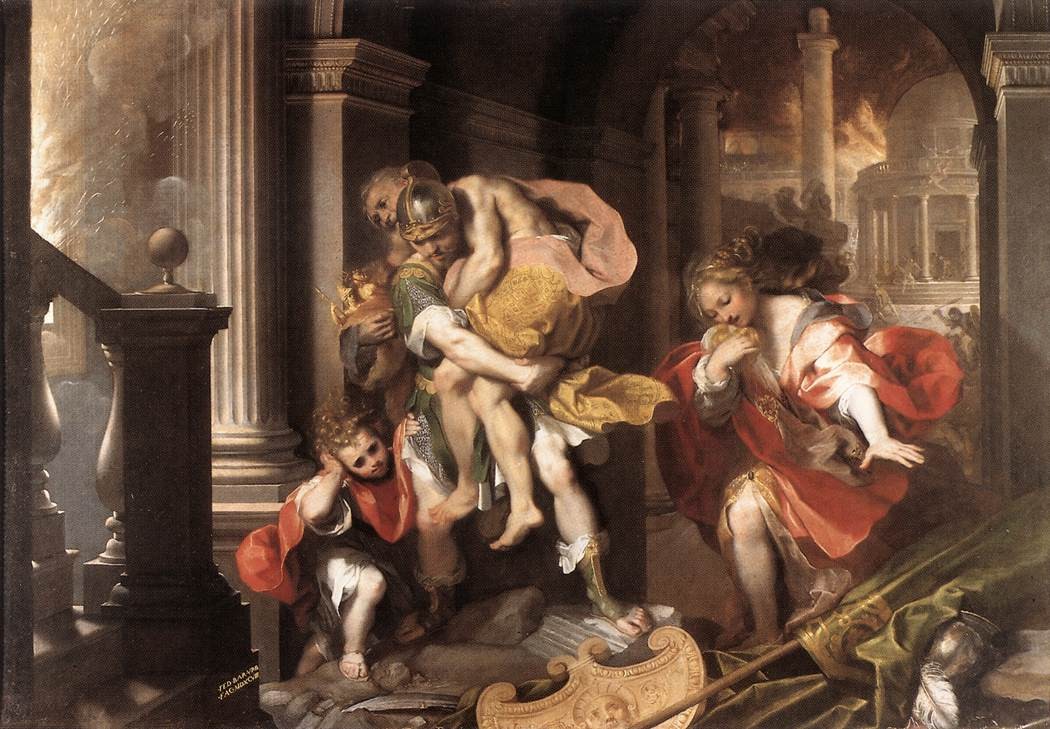
Pietas is the duty toward the gods, family, and the state. The poet Virgil embodies it in Aeneas, who sacrifices personal desire to a collective mission [8]. In Book 2, as Aeneas flees burning Troy, Virgil illustrates him carrying his aged father on his back and leading his young son by the hand. See his speech of instruction to his family below, and pietas at work:
“Come then, dear father, clasp my neck: I will
carry you on my shoulders: that task won’t weigh on me.
Whatever may happen, it will be for us both, the same shared risk,
and the same salvation. Let little Iulus come with me,
and let my wife follow our footsteps at a distance.
You servants, give your attention to what I’m saying.
At the entrance to the city there’s a mound, an ancient temple
of forsaken Ceres, and a venerable cypress nearby,
protected through the years by the reverence of our fathers:
let’s head to that one place by diverse paths.
You, father, take the sacred objects, and our country’s gods,
in your hands: until I’ve washed in running water,
it would be a sin for me, coming from such fighting
and recent slaughter, to touch them.”
(Aeneid 2.707−20)
Picture caption: Federico Barocci, Aeneas' Flight from Troy, 1598, oil on canvas, 179 × 253 cm. Galleria Borghese, Rome, Italy. Public domain, via Wikimedia Commons.
Another important Roman value is Fides — loyalty and one's given word, the foundation of alliances and pacts with soldiers [1][8]. Constantia is perseverance even under the most trying circumstances, until securing success [6]. Disciplina, in the military context, is the value Romans credited with their victories: a disciplined army, they believed, would prevail over one that lacked it [7].
These values generated two concrete social rewards: dignitas (earned reputation) and auctoritas (the prestige and influence that followed from it) [1][6]. It's no surprise that late-Republican historians — Cato, then Cicero — read Rome's decline precisely as a gradual abandonment of these principles in favor of personal ambition [7].
A Greek mirror: virtus and arete
Long before Rome, the Greeks had their own word for this cluster of qualities: arete (ἀρετή), usually translated as "virtue" or "excellence." The Greeks used it broadly: a horse, a knife, or a person could all have arete, meaning each did what it was meant to do exceptionally well [13]. In Homer, arete belonged above all to the battlefield — Achilles embodies it, and so do the warrior-aristocrats of the Iliad, for whom excellence in combat justified their privileged place at the feast and in council [14]. Only later, with Socrates, Plato, and Aristotle, did arete expand to include intellectual and civic virtue — wisdom, justice, the "philosopher-king" ideal [13][15].
Virtus is Rome's version of this Greek idea — like arete, it's rooted in manliness and battlefield courage [16]. But the comparison isn't so simple, argues classicist Myles McDonnell: in the third and second centuries BC, before Greek philosophy took hold in Rome, arete had already broadened into something more ethical, while virtus still meant almost exclusively physical toughness, aggression, and battlefield prowess. It wasn't yet "virtue" in the broader sense we associate with the word today [17]. Only later, from the 2nd century BC on, as Roman elites absorbed Greek philosophy through conquest, did virtus gradually pick up arete's broader moral meaning in terms of ethical range — justice, wisdom, temperance — layered on top of its older, harder warrior and martial core [11].
Even so, a Roman commander could quote Plato in the Senate, yet still measure his own worth, beneath the philosophy, by what he had survived on the battlefield — a martial core that Greek arete, by Plato and Aristotle's time, had already moved well beyond.
Reading Rome through a modern lens
It's tempting to read virtus and gravitas as "transformational leadership" avant la lettre. The gravitas study cited above draws exactly this comparison, noting that modern transformational leadership asks leaders to put organizational success ahead of self-interest — precisely what pietas demanded of the Roman commander toward the state [4]. The same study observes that gravitas didn't disappear with Rome: it can be traced through the ideal of the Victorian and Edwardian English gentleman, and it remains a prized trait in elite English schools today [4].
On the other hand, cross-cultural leadership research – see the GLOBE Study, the largest project of its kind ever conducted, surveying over 17,000 managers across 62 countries -- argued that there is no universal model of "good leadership" [5]. What a collectivist culture (much of Asia, Latin America) reads as loyalty and mutual protection, an individualist Western culture may perceive as paternalism or a lack of autonomy [5][9]. GLOBE also distinguishes a dimension the Romans would have recognized well — performance orientation, how much a culture rewards concrete achievement — from a more modern one, humane orientation, how much it values fairness and mutual care [10]. Virtus and disciplina sit close to pure performance orientation; clementia and family-oriented pietas lean closer to humane orientation. A Roman emperor had to hold both together — not unlike a contemporary leader expected to be both effective and humane.
There's also a more uncomfortable point: the mos maiorum was not only an ethical code — it was also a rhetorical device, a way for elites to legitimize present-day power by invoking an idealized past [3]. The same study notes that this exact mechanism was used by America's Founding Fathers, who looked to Cicero and Sallust, and resurfaces today in political rhetoric that invokes "the values of the ancestors" to draw a sharp line between who belongs to a nation's story and who doesn't [3]. There is a useful warning here -- ancient values are powerful tools of cohesion but also of exclusion, if handled without critical distance.
Virtus didn't die with the Roman Forum: it survives, under another name, every time we ask a leader to "hold steady" through a storm — that's gravitas in applied terms. And the Roman emperor's old balancing act — performance on one side, humanity on the other — is still the job description for anyone leading people through extreme conditions today: a flight crew on a long-duration mission, a pilot in a degraded cockpit, a diver at depth. Hold the line, and hold the person.
The lesson isn't "the Romans got it right." It's that every culture, and every high-stakes environment, builds its own model of what good leadership requires, shaped by whatever it most needs to protect — discipline for a legion, composure for a flight deck, trust for a crew sealed together for months at a time. Recognizing that pattern, rather than assuming one model travels everywhere unchanged, is the starting point for leading people well — across disciplines, environments, and cultures. It's a pattern worth holding onto — in research, and in practice.
About the Author
Dr. Mariateresa Sestito is a neuroscientist, clinical psychologist specialized in human factors, pilot, and founder of Ad Astra Human Science. Her work focuses on human performance, leadership, safety and extreme operational environments.
References
- Mos maiorum, Wikipedia (EN) https://en.wikipedia.org/wiki/Mos_maiorum
- Iacoboni, A. (2019). The legal value of mos maiorum in Cicero. Studia Iuridica, 80, 135-154.
- Emory University, American Ethnonationalism and the Mos Maiorum: 21st Century Rhetoric with Roots in the Late Roman Republic (thesis, Emory Theses and Dissertations) https://etd.library.emory.edu/concern/etds/76537255s
- Transformational leadership and gravitas: 2000 years of no development?, Personality and Individual Differences, ScienceDirect https://www.sciencedirect.com/science/article/abs/pii/S0191886919306993; see also Second Pleading of Cicero in the Gaius Verres Trial(Second Book)
- Cross-cultural leadership, Wikipedia https://en.wikipedia.org/wiki/Cross-cultural_leadership
- "Early Roman Society, Religion, and Values", Gender and Sexuality in Ancient Rome, Pressbooks Claremont https://pressbooks.claremont.edu/clas112pomonavalentine/chapter/94/
- Mos Maiorum: Moral Code Of Ancient Rome https://www.afrikaiswoke.com/mos-maiorum-code-of-ancient-rome/
- Significance of the mos maiorum in Roman culture, World History Edu https://worldhistoryedu.com/significance-of-the-mos-maiorum-in-roman-culture/
- Leadership and Culture: What Difference Does it Make?, Regent University https://www.regent.edu/wp-content/uploads/2022/10/Regent-Research-Roundtables-2022-Global-Consulting-Segundo.pdf
- The GLOBE Framework, Principles of Leadership & Management, eCampusOntario Pressbooks https://ecampusontario.pressbooks.pub/leadershipandmanagement/chapter/9-5-the-globe-framework/
- Virtus, Grokipedia https://grokipedia.com/page/Virtus
- Virtus in the Roman World: Generality, Specificity, Gettysburg Historical Journal, Volume 15 https://cupola.gettysburg.edu/cgi/viewcontent.cgi?article=1154&context=ghj
- Arete, Wikipedia https://en.wikipedia.org/wiki/Arete
- Arete Part 2, Jackson Hole Classical Academy https://www.jacksonholeclassicalacademy.org/news-detail?pk=1366241
- Decoding the Word 'Ἀρετή' (Arete): Virtue, Excellence, and the Heart of Ancient Greek Ethics, Saint Augustine's University https://explore.st-aug.edu/exp/decoding-the-word-arete-virtue-excellence-and-the-heart-of-ancient-greek-ethics
- 'Virtus' in Ancient Rome, Brewminate https://brewminate.com/virtus-in-ancient-rome/
- Myles McDonnell, Roman Manliness: Virtus and the Roman Republic (review), Project MUSE https://muse.jhu.edu/article/808436/summary
