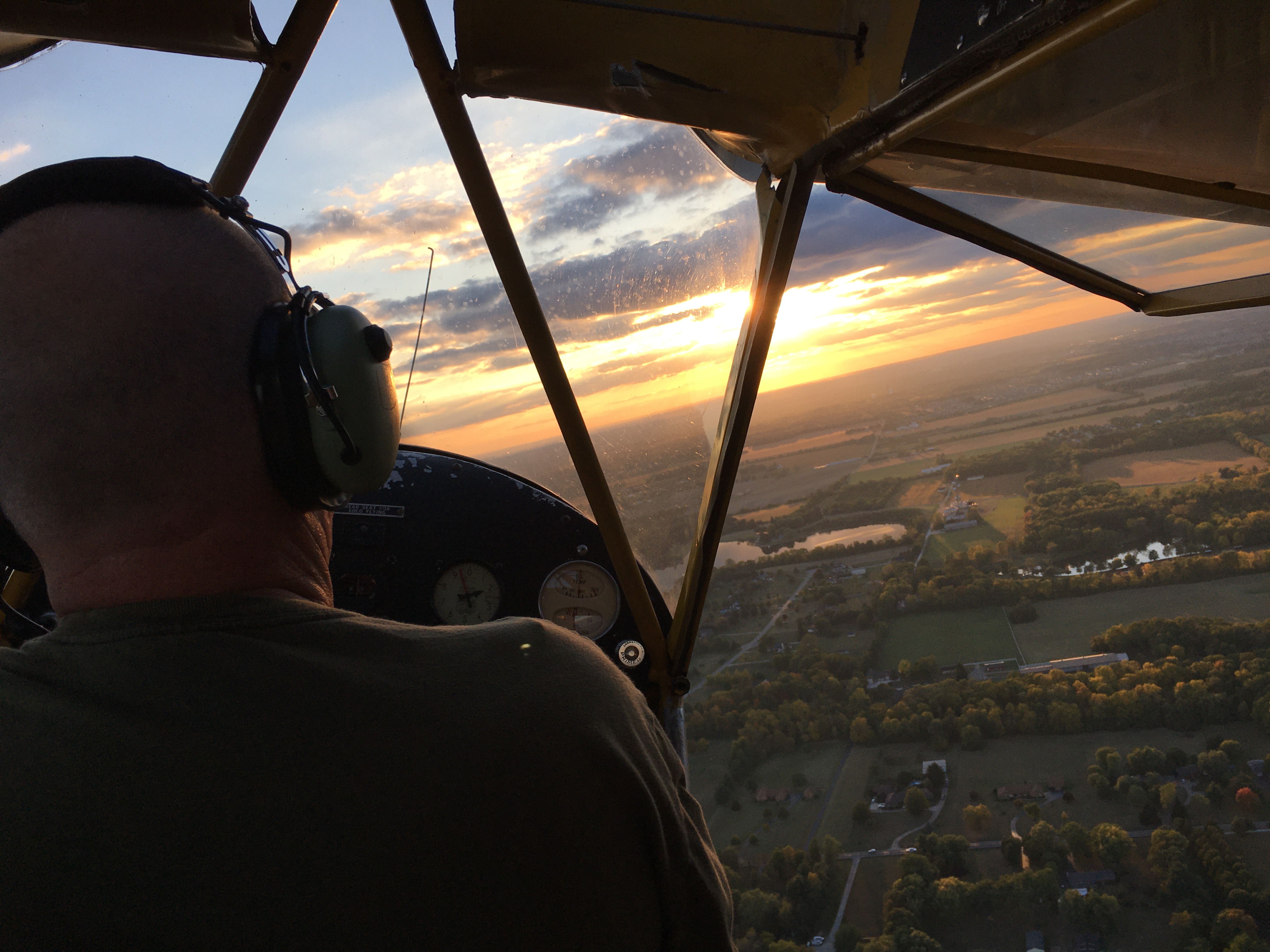
Since the opening of Red Stewart Airfield in 1946, we have started the training for all prospective pilots in conventional gear or, in other words, tailwheel aircraft. Our policy is that a student pilot must master their primary flight skills and initial solo in a tailwheel aircraft prior to progressing to newer tricycle aircraft. The question people have is, why?
Until the 1950’s most aircraft were produced as tailwheel aircraft. They could be designed and built more easily, with lighter weight due to the small and simple tailwheel versus the heavier and more complicated nose wheel design. Tailwheel aircraft can handle rough terrain much better due to lighter designs, the small steerable tailwheel, and the increased propeller clearance. Tricycle aircraft can get stuck in soft terrain much more easily as the combination of the heavier nose wheel and physics of the rotating propeller tends to force the nose-wheel deeper into any soft ground. Propeller strikes are more probable as well.
However, tailwheel aircraft are a bit more challenging to fly versus a tricycle aircraft. Note, I didn’t say more difficult, just more challenging. It takes a higher level of skill with the feet to control the yaw of the aircraft with the rudder in a tailwheel aircraft. The reason for this is that the center of gravity of the aircraft falls behind the main gear of the aircraft. With this location of the center of gravity, the tail of the airplane “wants” to swing around and become the nose of the aircraft while on the ground. If the pilot does not control this tendency while taxing, taking off and landing, the tail can swing around uncontrolled with inertia. This is known as a ground loop. At a low speed, it is inconsequential and results in an embarrassing low-speed tight spin of the aircraft. However, at a higher speed, the outside wing in the spin can begin lifting, i.e., flying, while potentially striking the inside wing as it is lowered to the ground. This has the potential of severely damaging the internal structure of the wing such as cracking or bending the main wing spar.
While, in flight, older tailwheel aircraft tend to demonstrate more adverse yaw when banking the airplane for a turn. Adverse yaw is when the nose of the aircraft swings in the opposite direction of the banked wings. Your feet must work in a coordinated fashion as you bank the airplane with your hands to counteract this adverse yaw. Of course, you must also learn to not apply too much rudder as well. While banking the aircraft to initiate a turn, the nose of the aircraft should not yaw away from the bank, nor should it yaw into the bank. i.e., there should be no yaw when turning an airplane coordinately.
The newer the aircraft, the more the engineers have designed out the need to use the rudder. In other words, engineers have eliminated much of the adverse yaw in newer airplanes, thus requiring less rudder usage.
When Cessna started mass-producing tricycle geared aircraft in the 1950’s, part of their marketing was to call them “Land-O-Matic". This is because it takes a little less skill to land a tricycle aircraft versus a tailwheel aircraft. The combination of the heavier weight, the center of gravity being ahead of the main gear and the lower tendency to ground loop, all make the tricycle geared aircraft easier to land and control versus a tailwheel aircraft especially in crosswind and gusty conditions. This is one of the reasons most flight schools use tricycle aircraft.
We believe that developing the skills required to fly a tailwheel aircraft from the start greatly benefits the student. While it’s more of a challenge to master a tailwheel aircraft, the benefits far outweigh beginning training in a tricycle aircraft. A pilot that has never flown a tailwheel aircraft must receive training and an endorsement to allow them to fly and carry passengers in tailwheel aircraft. When giving the training required for this endorsement, we notice the shortcomings many tricycle aircraft pilots possess in the use of their feet and hence rudder control. We often have to spend a certain amount of training just to get the pilot to fly a tailwheel aircraft coordinately or, in other words, use their feet properly. We often say that it is harder to move from flying a tricycle aircraft to a tailwheel aircraft versus the other way around. This is an example of the Learning Law of Primacy. The first things learned are hard to overcome when trying to teach a new skill.
There’s an old saying: “Once you learn to fly a J3 Cub, you can fly anything after that!”. There is a lot of credence to that statement. The footwork skills you develop in a tailwheel aircraft will greatly enhance your ability to fly a multi-engine aircraft. The biggest skill to master when flying multi-engine aircraft is learning to fly them with only one engine operating. With only one engine operating, there is a huge yaw moment occurring. This yaw moment must be controlled with proper rudder inputs from your feet. The initial skills you developed in learning to fly that tailwheel aircraft kicks in and makes the multi-engine learning curve much less severe.
The last couple of reasons we start all students in tailwheel aircraft are cost and enjoyment. While some flight schools may charge a premium for training in a tailwheel aircraft, the operating costs of these aircraft are considerably less given their simple design and lack of electrical equipment. Our philosophy is to promote the love of aviation by keeping it as affordable as flying can be. The last aspect of flying a tailwheel aircraft, especially a J3 Cub, is the sheer joy you feel flying along at 1,000’ on a warm fall day with the door open and wind blowing in your face as you watch the trees turn shades of red below you. In the most basic sense, this is really what learning to fly is all about.
About the Author
Michael Stewart is an Air Transport Pilot (ATP, CL65,757/767 type rated) and Certified Flight Instructor (CFI, CFIG, MEI). He trains powered and glider students at Red Stewart Airfield in Waynesville, Ohio and enjoys flying tailwheel aircraft alongside Ad Astra Human Science founder Dr. Mariateresa Sestito. His activity focuses on flight instruction, tailwheel proficiency, and the foundational skills that carry pilots from primary flight training through their first solo to multi-engine and airline carriers.